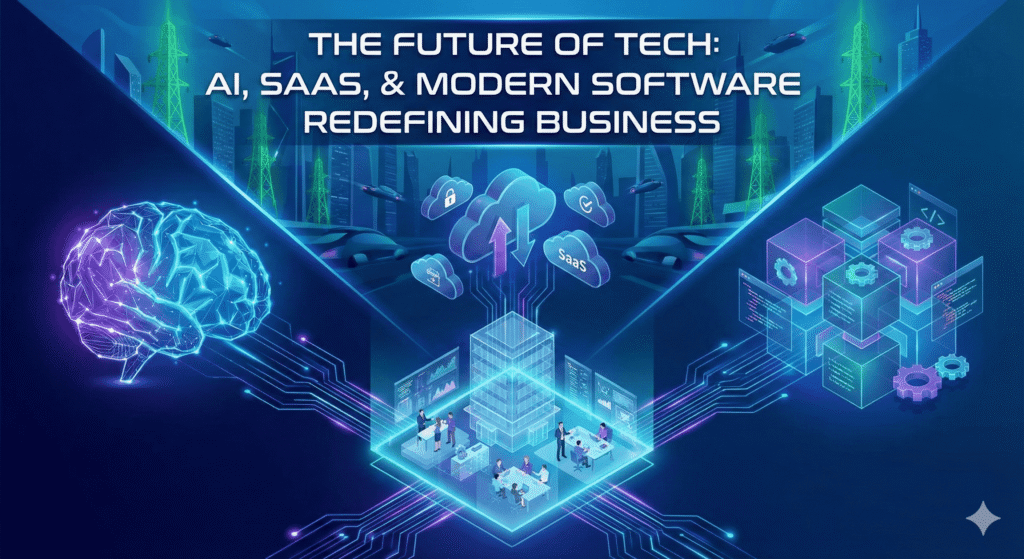
Technology is evolving faster than ever before. Artificial intelligence is entering every part of our workday, SaaS platforms are replacing traditional software at record speed, and businesses of all sizes are investing in digital transformation. Whether you’re a founder, developer, marketer, or entrepreneur, one thing is clear: we are entering a new era of software-driven innovation.
In this blog post, we’ll explore the changing landscape of tech—how AI is shaping decision-making, how SaaS has become the backbone of modern businesses, and where software development is heading next. We’ll also look at real-world examples and emerging trends that are already defining the decade ahead.
The Tech Landscape Today: Faster, Smarter, Always On
Technology has always been a catalyst for change, but the last five years have delivered a particularly intense wave of innovation. We’ve seen:
- The rise of generative AI tools that automate creative, analytical, and operational tasks
- A surge in cloud adoption, with over 94% of organizations now using cloud services in some capacity
- SaaS becoming the default software model, with the global SaaS market projected to reach $1 trillion by 2030
- Increased demand for automation, low-code tools, and scalable digital infrastructure
At the center of all this change is a shift in what businesses expect from technology: speed, efficiency, flexibility, and intelligence. And those expectations are reshaping the software industry from the ground up.
AI: The Engine Driving the Next Generation of Software
Artificial intelligence is no longer futuristic—it’s fully embedded in—and transforming—modern software.
From Automation to Intelligence
Earlier generations of business software focused on automation: completing repetitive tasks faster, without human input. But AI-enabled systems go further. They offer:
- Predictive insights
- Personalized recommendations
- Natural language processing
- Real-time pattern recognition
- Autonomous decision-making
For example, consider customer support. Traditional chatbots handled simple queries, but AI-powered support agents can:
- Understand context
- Retrieve data from multiple sources
- Predict customer needs
- Offer solutions using natural language
- Learn and improve with every interaction
This shift saves businesses both time and money while improving customer satisfaction.
Generative AI Is Rewriting How We Work
Generative AI—popularized by tools like ChatGPT, Midjourney, and automated coding assistants—has changed the way teams collaborate and create. Tasks that used to take hours can now be completed in minutes:
- Drafting blog posts
- Generating marketing ideas
- Writing or debugging code
- Designing interfaces
- Analyzing data
- Creating product roadmaps
But the true revolution is the ability to integrate generative AI directly into SaaS platforms. This is giving rise to “AI-native SaaS,” a new breed of tools that rely on intelligence as a core function rather than a bonus feature.
Case Study: How AI Improves Product Development
Consider a mid-sized software company developing a new mobile app. In the past, the process might take months of planning, testing, and iteration. With AI, teams can now:
- Generate UI prototypes in minutes
- Auto-test code before deployment
- Analyze user behavior to personalize experiences
- Predict which features will improve engagement
- Automate bug detection to speed up release cycles
Companies that adopt AI in product development report up to 40% faster time-to-market and up to 30% reduction in operational costs.
The SaaS Revolution: Why Everything Is Moving to the Cloud
SaaS (Software as a Service) has fundamentally changed how companies buy and use software. Instead of installing applications locally, businesses access software directly through the cloud—paying only for what they need.
Why SaaS Became the Default Choice
There are several reasons SaaS dominates the software ecosystem:
1. Lower Upfront Costs
Traditional software often required expensive licenses, hardware, and IT staff. SaaS flips that model with subscription-based pricing that reduces upfront expenses.
2. Instant Scalability
Teams can add or remove users anytime, scale resources based on demand, and expand globally without additional infrastructure.
3. Continuous Updates
SaaS platforms deliver updates automatically—no manual installs, no downtime, and access to the latest features instantly.
4. Seamless Integration
Modern SaaS products are built to connect. Companies can integrate:
- CRM
- Marketing automation
- Cloud storage
- AI analytics
- Internal applications
This creates a more cohesive ecosystem across the organization.
The Expansion of Vertical SaaS
One notable shift in recent years is the rise of vertical SaaS—platforms built specifically for niche industries.
Examples include:
- Toast for restaurant management
- Procore for construction companies
- Veeva for life sciences
- Shopify for e-commerce
- Clio for legal practice management
These specialized platforms offer a deeper feature set tailored to specific workflows—something generic software often cannot match.
Example: SaaS Transformation in Small Businesses
A small retail brand that once relied on spreadsheets can now operate with:
- Shopify for online stores
- Klaviyo for email automation
- QuickBooks Online for accounting
- Slack for team communication
- Zapier to automate repetitive tasks
This stack allows a lean team to operate like a much larger enterprise.
The Future of Software: Trends Reshaping the Industry
As AI, SaaS, and modernization continue to evolve, several key trends are emerging that will define the future of software.
1. AI-Native SaaS Will Become the Standard
In the next decade, we will see more SaaS products that:
- Use AI as the default interface
- Learn user preferences in real time
- Automate entire departments
- Predict customer behavior with high accuracy
- Offer customized experiences for every user
AI won’t just be a feature—it will be the backbone of software architecture.
2. Low-Code and No-Code Development Will Empower Everyone
Low-code tools are already enabling non-technical teams to build applications and workflows. Platforms like Airtable, Bubble, and Notion are empowering users without coding backgrounds to create:
- Internal apps
- CRM systems
- Automated workflows
- Web applications
This trend will accelerate, allowing businesses to innovate faster without waiting for engineering bandwidth.
3. Increased Demand for Cybersecurity and Data Privacy
As cloud adoption grows, so do security threats. Organizations are investing in:
- Zero-trust security models
- AI-powered threat detection
- Encrypted data storage
- Identity and access management
The companies that provide strong, transparent privacy safeguards will stand out in an increasingly digital world.
4. Hyper-Personalization Will Become the Norm
AI’s ability to analyze real-time data means software experiences will become more personalized:
- E-commerce sites will tailor every product suggestion
- SaaS platforms will adjust dashboards based on role
- Apps will predict user needs before they ask
Personalization is no longer a nice-to-have—it’s a competitive advantage.
5. The Rise of Autonomous Software
The next evolution of software is autonomy: applications that can take action without human prompting.
Examples include:
- AI agents that manage marketing campaigns
- Systems that optimize cloud resources automatically
- Apps that identify and fix bugs before users encounter them
- Tools that manage customer outreach proactively
Autonomous software will allow businesses to operate with higher efficiency and lower human error.
Conclusion: The Next Era of Software Is Intelligent, Adaptive, and Limitless
Technology is evolving in powerful ways that reshape how we work and build businesses. AI is bringing intelligence to every tool we use, SaaS platforms are enabling unprecedented scalability, and modern software is becoming more autonomous and intuitive.
The companies that thrive in this new era will be the ones that embrace innovation, invest in digital transformation, and adopt technologies that enhance productivity and decision-making.
If your organization hasn’t started exploring AI integration, cloud SaaS tools, or automation, now is the time to begin. The future of tech isn’t coming—it’s already here.